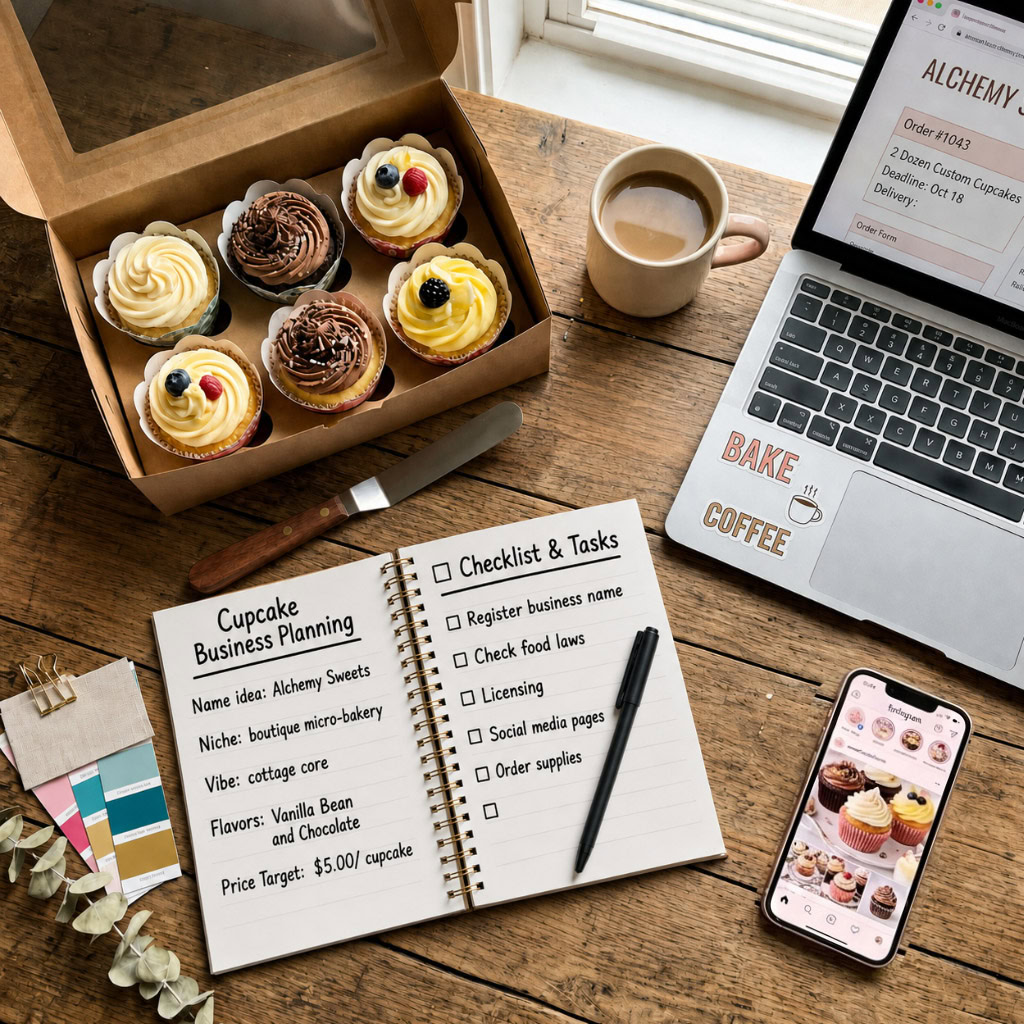
I wanted to start a home bakery.
I loved decorating cakes and cupcakes, and turning that into a little business felt like the obvious next step. So I started figuring out what it would actually take, and quickly realized there was a lot more to it than ‘bake it, box it, sell it.’
This isn’t a step-by-step guide to launching a bakery. It’s the list of questions I found myself working through along the way: what to sell, where to sell it, what I was legally allowed to do, whether I even had the space, and whether the numbers made sense.
Some of these I figured out the hard way. A few of them changed my mind entirely.
If you’ve ever thought about selling your cupcakes, cakes, or other baked goods, these are the things worth thinking through before you buy the mixer and order 500 boxes.
Table of Contents
1. What Are You Actually Going to Sell?
Start by thinking about the products you want your business to offer.
You might be interested in:
- Cupcakes
- Decorated cakes
- Cookies
- Cake pops
- Cakesicles
- Cupcake bouquets
- Seasonal products
- Custom orders
- Wedding or event orders


A business selling simple boxed cupcakes has very different needs from one producing elaborate wedding cakes or highly decorated floral cupcakes.
Consider:
- How complicated your products are
- How much customization you’ll offer
- How long they take to make
- What ingredients they require
- What equipment you’ll need
- How they need to be stored and transported
- What type of customer you’re trying to attract
You may also want to think about what you don’t want to offer.
It can be tempting to say yes to every request when you’re trying to build a customer base, but having some boundaries around your menu and customization can make the business much easier to manage.
2. What Are the Regulations In Your Area?
Before you get too far into planning, find out what you’re actually allowed to do.
Home-based food businesses can be subject to different regulations or rules depending on where you live and what you’re selling.
You may need to investigate things such as:
- Food safety requirements
- Business licensing
- Home occupation/cottage food requirements
- Permits
- Approved kitchen requirements
- Food preparation restrictions
- Labelling requirements
- Insurance
- Requirements for selling at markets or events
Requirements can vary considerably by location.
This was one of the biggest factors in my menu decision. In my area, per regulations I couldn’t sell frostings or buttercreams containing cream, milk or eggs, and could only use these ingredients if they were baked into a product. That limited what I could offer but in a way it helped narrow my menu.
3. Where Are You Going to Sell?
This is easy to overlook, because it feels like the answer is obvious: you take orders online and customers pick up from your home. That is one option, but it’s not the only one. You could also sell through delivery, at farmers’ or craft markets, at community events or weddings, through local business partnerships, or on Facebook Marketplace and local groups.
Where you sell changes how you need to operate. Selling from home and selling at a market, for example, come with completely different sets of logistics.
Selling From Home
If customers pick up orders at your house, you’ll need to think through things such as:
- Pickup times
- Where customers will park
- How they’ll collect their orders
- Delivery, and whether you’ll handle it yourself or use a third-party service
- Keeping your home and personal life separate from the business
- Whether home-based customer traffic is even allowed under your local rules
Selling at Farmers’ Markets and Other Markets
Markets come with their own layer of requirements. Some markets have rules about what vendors can sell and where those products can be prepared/ Beyond that, you may need to think about:
- Vendor fees
- Vendor permits
- Additional food safety requirements
- Insurance
- Approved food preparation facilities
- Transportation
- Tables and table coverings
- Displays and signage
- Pricing signs
- Packaging
- Payment processing
- Power or refrigeration needs
- How you’ll keep products protected during the event
If farmers’ markets are part of your plan, look into the requirements before assuming you can just show up with your cupcakes. The same goes for other events. Organizers set their own rules, and those rules can affect both your costs and how you produce your products.
4. Do You Have Enough Space?
A home baking business can take up considerably more space than you might expect.
Think about:
Baking Space
- Counter space
- Oven capacity
- Mixer
- Cooling racks
- Ingredient preparation
- Cleanup
Decorating Space
- Piping
- Buttercream preparation
- Food colouring
- Decorating tools
- Finished products waiting to be boxed
- A clean area where products can remain undisturbed
Storage
- Ingredients
- Packaging
- Cake boards
- Boxes
- Decorating supplies
- Equipment
- Seasonal supplies
Refrigerator and Freezer Space
Buttercream, cakes, cupcakes, and other products may need refrigeration or freezer space depending on what you’re making.
A home kitchen might feel perfectly adequate when you’re making a dozen cupcakes for yourself. It can feel very different when you’re producing multiple orders while also storing boxes, ingredients, equipment, and other business related items.
5. How Much Can You Actually Produce?
Your available space is only part of the capacity question. You also need to consider how much you can realistically produce on a regular basis.
Think about:
- How many cupcakes you can bake at once
- Mixer capacity
- Decorating speed
- Refrigerator and freezer space
- Workspace and storage
- How long different designs take
- How many hours you actually want to work
- Whether you’re doing everything yourself or you have help
Think about your repeatable capacity, not just your maximum.
And remember that an order isn’t just decorating time:
Shopping → Baking → Cooling → Buttercream → Decorating → Packaging → Cleanup → Customer communication
A home baking business also isn’t just baking and decorating. Admin work, like responding to inquiries, managing orders, bookkeeping, marketing, and sourcing supplies, takes time too, and it eats into the same hours you have available to actually produce your products.

6. Who Are You Actually Selling To?
“I sell cupcakes” isn’t really a target market.
Think about who you want your customers to be.
Maybe you’re interested in:
- Parents ordering birthday cupcakes
- People looking for gifts
- Wedding and event clients
- Customers who want highly customized designs
- Customers looking for affordable everyday treats
- People specifically interested in floral buttercream
- Local businesses ordering for events
Your target customer can influence:
- What you sell
- How you price it
- How you photograph it
- Where you advertise
- How you package it
- How you communicate with customers
- How you brand the business
You don’t have to know your target customer with absolute certainty before you start.
But it’s worth thinking about who you’re hoping will actually buy what you’re making.
7. What Do You Want Your Business to Feel Like?
A small baking business isn’t only selling a physical product.
It’s also selling the experience of buying from you.
People may choose one home baker over another because they like their decorating style, photography, personality, communication, packaging, or overall aesthetic.
Think about:
- Your decorating style
- Your visual style
- Your personality
- Your customer experience
- The kind of products you want to be known for
- How you want people to feel when they interact with your business
Having some idea of what makes your business feel like you can help you make more consistent decisions as you build it.
8. What Will Your Branding Look Like?
Branding is more than a logo. It is also something you can get tied up in for too long.
It can include:
- Business name
- Logo
- Colours
- Fonts
- Packaging
- Photography
- Website
- Social-media presence
- Tone of voice
- Product presentation
Your branding doesn’t have to be elaborate, especially when you’re starting out. But consider whether the different pieces of your business look and feel like they belong together.
If your website, packaging, social media, and product photography all communicate completely different things, it can be harder for customers to develop a sense of what your business is about.
It’s also easy to get tied up in branding for far longer than it deserves at the start. Your branding doesn’t have to be perfect before you launch, and it’s not permanent. It’s ok to change your name, logo, or overall look later as you figure out what actually fits your business.

9. How Will People Find You?
Once you know who you’re trying to reach, think about where those people will actually find you.
Possible options include:
- Your website
- Local community groups
- Word of mouth
- Markets and events
- Local business listings
- Partnerships with other businesses
- Paid advertising
You don’t need to be everywhere. In fact, trying to maintain every social platform can quickly become another full-time job and lead to serious burnout (trust).
Consider where your potential customers are actually looking for the type of products you sell and focus your efforts there.
Photography Is Part of This Too
Because baked goods are visual products, your photography can be an important part of how people discover and evaluate your business.
Think about whether your photos show:
- The actual products you sell
- Different designs
- Close-up decorating details
- Full boxes or arrangements
- Packaging
- The scale of your products
- The overall style of your business
You don’t need an expensive camera to start building a useful portfolio. A phone and good lighting are all you need.
10. Where Will You Get Your Supplies?
Ingredients are the obvious one, but you’ll potentially need suppliers for more than that too:
Packaging
- Cupcake boxes
- Inserts
- Cake boards
- Bags
- Labels
- Stickers
- Bouquet packaging
Decorations
- Sprinkles
- Toppers
- Edible decorations
- Ribbons
- Other decorative supplies
Business and Branding
- Printed materials
- Labels
- Stickers
- Business cards
- Packaging materials
Tools & Equipment
- Mixer
- Baking pans
- Piping tips and bags
- Cooling racks
- Scales and measuring tools
- Storage containers
Consider not just the price, but also:
- Availability
- Shipping costs
- Minimum orders
- Consistency
- How quickly you can get replacements
- Whether you can reliably source the products you need
A product isn’t very useful to your business if you can’t reliably get the supplies required to make it.
11. What Will the Business Actually Cost to Run?
In addition to all the physical supplies listed above, running a home baking business comes with costs that are easy to overlook.
Your business may have ongoing expenses such as:
- Equipment replacement
- Kitchen rental
- Utilities
- Website and domain
- Email marketing
- Software and subscriptions
- Payment processing
- Insurance, if required
- Business registration or licensing
- Advertising
- Delivery and transportation
- Market or vendor fees
- Cleaning supplies
- Miscellaneous expenses
You don’t need to know the exact cost of every expense before you start, but you should have some idea of what your ongoing expenses are likely to look like.
This is also why pricing individual products and understanding your overall business expenses are two different things.
→ How to Price Cupcakes, Cakes & Other Baked Goods
12. How Will Orders, Payments, Pickup and Delivery Work?
Think about what happens after someone decides they want to buy from you.
How will they actually place an order? Options include:
- A Google Form or online order form
- DM or message via social media
- Text
- Phone call
- In person, at a market or event
And once they’ve ordered, how will they pay? Think about:
- Cash
- E-transfer, Venmo, or similar payment apps
- Card or online payment processing via website
- Deposits vs. full payment upfront
You may also need policies around:
- Minimum orders
- Required notice
- Deposits
- Payment deadlines
- Cancellations
- Changes to orders
- Pickup windows
- Delivery areas and fees
The important thing is to have a process that keeps orders organized and makes expectations clear to both you and your customers.
Here is a sample cupcake order google form:

13. What Will You Need to Track?
Running a home baking business also means keeping track of information, not just baking and decorating. Think about what you’ll need to record and stay on top of:
- Orders and order details
- Customer contact information
- Payments received
- Outstanding balances
- Ingredient and supply inventory
- Expenses
- Income
- Recipes and formulations
- Pricing
- Repeat customers
- Feedback or complaints
You don’t need an elaborate system from day one, a spreadsheet is often enough to start. But having somewhere to track this information keeps you from relying on memory, texts, and DMs to run your business.
14. Does the Business Model Make Financial Sense?
This is where all of the previous considerations start coming together.
You might have a product that sells for $5 and costs $2 in ingredients and packaging.
That doesn’t automatically mean you made $3.
You still have other business expenses, and you’ve spent your time producing the product.
And even if an individual product is profitable, the business as a whole may not be.
For example, if your business has $5,000 in total expenses but only brings in $3,000 in sales, the business isn’t profitable.
This is why it’s worth thinking about things such as:
- Your average order value
- Your direct product costs
- Your ongoing expenses
- Your production capacity
- How many orders you could realistically take
- How much time you’re willing to spend
- How much revenue you need the business to generate
You don’t need a perfect financial projection before starting.
But you should have some idea of whether the business model you’re imagining could realistically support itself.
→ How to Price Cupcakes, Cakes & Other Baked Goods
15. Do You Actually Want to Run a Home Bakery?
This might be the most overlooked question of all.
It’s easy to think:
I love baking → I should sell baked goods.
But running a baking business involves much more than baking.
You’ll potentially spend time (if not more time) on:
- Customer communication
- Scheduling
- Shopping
- Ordering supplies
- Cleaning
- Packaging
- Marketing
- Photography
- Bookkeeping
- Website management
- Administration
You may find that you love this more as a hobby than as the thing you want to sell and grow into a profitable business.
The experience helped me understand that being good at something, and even loving it, doesn’t necessarily mean that turning it into a certain type of business is the right call.
Before You Start: Things to Think Through
You don’t need to have every answer perfectly figured out before you begin.
But before spending a lot of money or accepting regular orders, it helps to have considered:
- What am I selling?
- What am I legally allowed to sell from my location?
- Where am I going to sell it?
- What requirements apply to those sales channels?
- Do I have enough baking, decorating, refrigeration, and storage space?
- How much can I realistically produce?
- Who am I trying to sell to?
- What is the vibe I’m going for?
- How will I brand it?
- How will customers find me?
- Where will I source ingredients, packaging, and supplies?
- What will the business cost to operate?
- How will customers order, pay, pick up, or receive their products?
- How will I keep track of the business?
- Does the overall business model make financial sense?
- Do I actually want to run a baking business?
Starting a home cupcake or baking business can look deceptively simple: bake it, box it, sell it. But the product is only one part of the business. Where you can produce it, who you’re selling to, what it costs, and whether the numbers work all affect whether the idea is actually practical.
Working through these questions may lead you to change the business you originally imagined, and that’s okay. For me, trying to build a custom cupcake business was still valuable, even though I ultimately decided it wasn’t practical.
So before you buy the mixer, order 500 cupcake boxes, or start taking custom orders, take some time to think through the business behind the baking.